

Specialist healthcare in Preston
Radiology in Preston
Advanced MRI and ultrasound imaging to support accurate diagnosis and treatment planning.
Radiology services
Advanced imaging in Preston
At Greater Lancashire Hospital, we offer advanced MRI scans to diagnose conditions, plan treatments, and assess treatment effectiveness. Using powerful magnets and radio waves, MRI scans provide detailed images of the brain, spinal cord, bones, joints, and internal organs like the liver and heart. The procedure is safe, non-invasive, and performed by trained radiographers who guide you through each step. MRI results help ensure accurate diagnoses and effective treatment planning for a range of medical conditions.
MRI
What is an MRI scan?
Magnetic resonance imaging (MRI) is a type of scan that uses strong magnetic fields and radio waves to produce detailed images of the inside of the body.
An MRI scanner is a large tube that contains powerful magnets. You lie inside the tube during the scan.
The results of an MRI scan can be used to help diagnose conditions, plan treatments and assess how effective previous treatment has been.
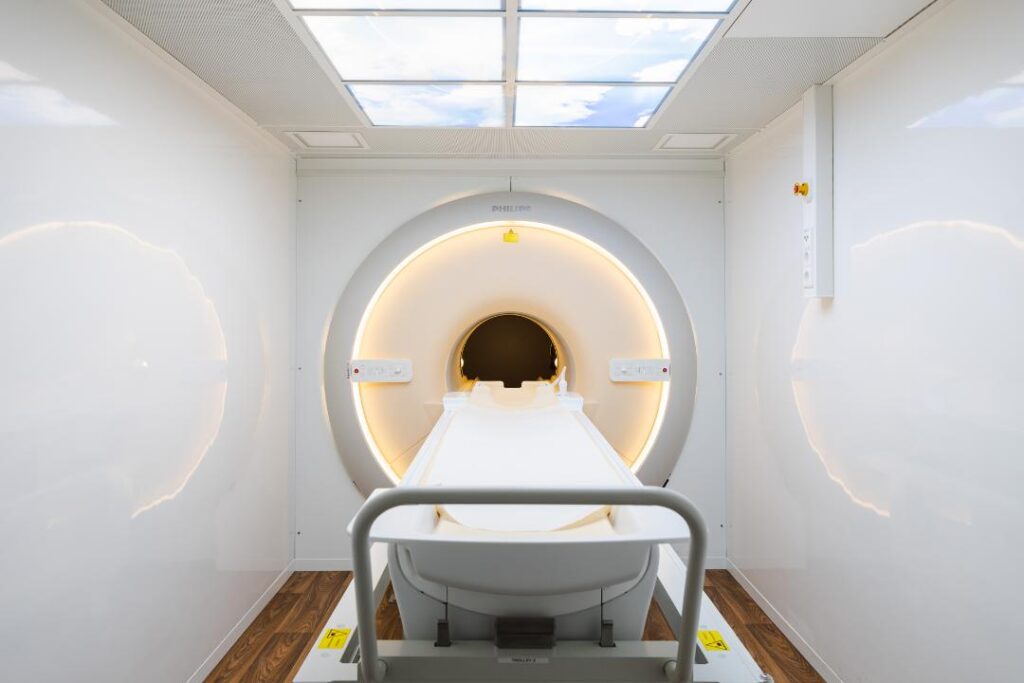
MRI scans can be used to scan the:
Brain
Spinal cord
Bones and joints
Internal organs, such as the liver, womb or prostate gland
What happens during an MRI scan
Select a step below to learn more about what to expect during your scan.
How the scan is carried out
During an MRI scan, you lie on a flat bed that’s moved into the scanner. Depending on the part of your body being scanned, you’ll be moved into the scanner either head first or feet first.
Who operates the scanner
The MRI scanner is operated by a radiographer, who is trained in carrying out imaging investigations. They control the scanner using a computer, which is in a different room, to keep it away from the magnetic field generated by the scanner. You’ll be able to talk to the radiographer through an intercom and they’ll be able to see you on a television monitor and through the viewing window throughout the scan.
What you may hear and feel
At certain times during the scan, the scanner will make loud tapping noises. This is the electric current in the scanner coils being turned on and off. You’ll be given earplugs or headphones to wear. It’s very important to keep as still as possible during your MRI scan. The radiographer may ask you to hold your breath for a few seconds or follow other instructions during the scan. The scan lasts 15 to 90 minutes, depending on the size of the area being scanned and how many images are taken.
Ultrasound
Ultrasound scans
We also provide safe and effective ultrasound scans to diagnose conditions, monitor pregnancies, and assist in surgical procedures. Using high-frequency sound waves, ultrasound creates real-time images of the inside of the body. The procedure is non-invasive, with an ultrasound probe emitting sound waves that bounce back, creating an image displayed on a monitor. Ultrasound scans can be used to examine various areas such as the heart, organs, muscles, and joints. Whether external or internal, our trained professionals ensure a comfortable experience for all patients.
An ultrasound scan, sometimes called a sonogram, is a procedure that uses high-frequency sound waves to create an image of part of the inside of the body. An ultrasound scan can be used to monitor an unborn baby, diagnose a condition, or guide a surgeon during certain procedures.
External ultrasound scan
An external ultrasound scan is most often used to examine the heart, organs in the tummy and pelvis, muscles and joints and other organs and tissues that can assessed through the skin.
Internal ultrasound scan
An internal examination allows a doctor to look more closely inside the body at organs such as the prostate gland, ovaries or womb.
Preparing for an ultrasound scan
Before having some types of ultrasound scan, you may be asked to follow certain instructions to help improve the quality of the images produced. For example, you may be advised to:
Depending on the area of your body being examined, the hospital may ask you to remove some clothing and wear a hospital gown.
- drink water and not go to the toilet until after the scan – this may be needed before a scan of your unborn baby or your pelvic area
- avoid eating or drinking for several hours before the scan – this may be needed before a scan of your digestive system, including the liver and gallbladder
Related services
You may also be interested in
Cardiology
Expert diagnosis and treatment for heart and cardiovascular conditions.
Learn moreNeurology & Neurosurgery
Specialist care for disorders of the brain, spine and nervous system.
Learn morePrivate GP
Comprehensive, personalised private GP care for everyday health concerns, ongoing conditions and preventative healthcare.
Learn more
Contact our team
Expert care starts here.
Whether you’re seeking a consultation, diagnosis, or treatment, our team is here to help you every step of the way.